Hamstring Stretches

So my past few Instagram posts have shown me doing some hamstring stretches. I have torn one of my hamstrings twice – both times playing hockey, you would have thought I might have learned from my mistakes but apparently not! Therefore, I understand the importance of looking after this muscle group.

About the hamstring

The hamstring refers to a group of 3 muscles that run along the back of your thigh, from your hip to just below your knee. These are called Bicep Femoris, Semimembranosus and Semitendinosus

Your Hamstring muscles are not used much while standing or walking but are very active during activities that involves bending the knee, such as running jumping and climbing.

When does injury occur?

An injury occurs when any of the tendons or muscles are stretched beyond their limit. More often than not they occur during sprinting, lunging or jumping. More gradual slower movements can also cause the hamstring to overstretch.

Prevention 

  • Regular stretching
  1. Towel stretch
    Sit upright, loop a towel over your foot and hold each end. Pull your leg up and do NOT bend your knee, keep your other leg flat on the floor and your back straight. Hold for 20-30 seconds, relax and repeat 3 times on each leg
  2. Simple stretch
    Sit on the floor with both legs straight out in front of you. Extend the arms and reach forward by bending at the waist as far as possible. Keep your knees straight. Hold for 20-30 seconds and repeat 3 times.
  3. Hurdle Stretch
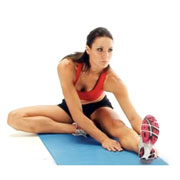
    Sit on the floor 1 leg straight out, bend the other leg at the knee and position sole of the foot against your opposite thigh. Extend arms and reach forward over the straight one by bending at the waist. Hold for 20-30 seconds, relax and repeat 3 times on each leg
  • Foam Roll
  • Massage
    If the hamstring is still tight after stretching and foam rolling then you need to book in for a Sports Massage. 30 minutes on just the hamstrings is enough to prevent an injury. You need to listen to your body otherwise you will end up with a tear like me and you will be out of training for weeks!

See my Instagram for pictures of the stretches @mollysportsmassage

Deep Tissue/ Sports Massage Myths

In this article I will be talking about a few myths people think/assume a Sports Massage or Deep Tissue will be like.

Background on Muscles

There are two primary categories of tissue that massage therapists address. They are the superficial tissue layers which include skin, fatty layer and superficial fascia. The other is the deep tissues or structures such as muscles, ligaments, tendons and deep fascia.

Superficial layers are massaged using Swedish or relaxation massage techniques which reduce stress and relax clients.

Deep tissue simply means you work with the deeper underlying structures, a variety of massage techniques will be used, some will involve a firmer pressure, and some will be a lot lighter. It always depends on a client’s needs and pain threshold as to how much pressure I apply.

The Myths

  • Deep tissue means a lot of pressure

Pressure is a personal preference, as a therapist I will listen to clients and what they need. Sometimes only lighter pressure is needed to achieve a good result. If I need to apply more pressure I will ask and only go as far as a client wants.

  • More pressure = better result

Massage is about applying a specific technique to an area of tissue to get a particular physiological response. Different areas require different techniques and therefore different pressures, for example you would not apply the same pressure on a trigger point and an adhesion.

  • Deep tissue massage is meant to be painful 

Sports Massage can be an intense treatment and pain may be felt, however this does depend on the level of tissue damage you have.

More damage = More pain.

If too much pressure is applied the muscle may tense up and as a reaction the client can move away from a therapist. This is when I adjust the pressure and adapt the pressure to the client’s needs. A too painful massage can be counterproductive and have the opposite result to the intended outcome.

Communication is key for this – tell me when the pressure is too much, and I will stop!

  • Bruising is a good thing

As a therapist I hate bruising people and it is a rare occurrence I can promise you. If you are prone to bruising, then please tell me so that I can ease off the pressure and be more careful.

Bruising is not a good thing – but due to the nature of the massage can sometimes happen.

As a therapist we can only go on client feedback, I cannot stress enough that ‘no pain no gain’ is a key element of sports massage. Yes, some pain may need to be endured to get results, but I am not a mind reader, I don’t know if what I am applying is too much unless you tell me! I will not be offended or judge you if you tell me it is too much for you.

Not all therapists are the same – one bad experience with a painful massage does not mean we are all like that! Try one and see!


Why should I get a Sports Massage?

A lot of people see massage as a luxury and not a necessity. When you think of a ‘massage’ you think nice music, gentle pressure and you leave feeling all relaxed. Sports Massage is not the same – it is a combination of serval massage techniques that are used to target specific muscle groups used during different activities/exercise. After a Sports Massage you will feel lighter, more powerful and more flexible. All of those nagging aches and pains will have been addressed which will help to reduce the likelihood of injury.

Injury prevention

The most important reason to get a sports massage is to help muscles, ligaments, tendons and joints to move though their full range of motion. You want your body to be able to perform at its best while you’re training, there is no point in not reaching your optimum performance just because of tight muscles.

Many injuries are brought about by overusing certain muscles. This can result in soreness, pain and inflammation. Regularly Sports Massages can help reduce the likelihood of the muscles becoming overused in the first place and can also help reduce the initial inflammation that leads to injury. Sports Massage can also reduce the chance of injury recurrence, it is most effective for treating soft-tissue injuries.

Pain reduction and relaxation

More often than not the pain you are feeling is a result of tight muscles. Sports Massage techniques will help to reduce the tension in the muscles which in turn will reduce the pain. Massage also flushes out the lactic acid and toxin in the muscles which will reduce that DOMS feeling post exercise (delayed onset muscle soreness).

Although a Sports Massage can be a bit painful and a deeper pressure, it is a great tool that you can use to reduce stress. A build-up of tension around your shoulders and neck can cause you to get headaches and makes you feel lethargic. Often after a massage you can find you are in a healthier psychological state as well as feeling physically relaxed.


If you want to continue training at a high intensity and be injury free, then you need to invest in yourself and get regular massage. I always say that massage every 4-6 weeks is what everyone should be doing, if you have a niggle or injury then a few massages closer together may be required.


Post Marathon Sports Massage

Congratulations to everyone who ran the marathon today – I hope you are all happy with your times!

Sports Massage is vital after a marathon, the most effective time to get a massage is 1-3 days after the event.

The style of the massage will be a bit different to your pre-event ones as the post-event massage will be focused on aiding the lymphatic system. This will help remove waste products and aid recovery. Therefore, the massage techniques used will be a bit lighter and more gentle – you will thank me for this as during the marathon micro damage will have occurred in your muscle tissues and a firm massage could make these worse. Not to mention it would HURT!

Some Benefits of Sports Massage Post Marathon:

  • Helping the circulatory system deal with the waste products which, if they stay in the muscles will cause pain
  • Reducing the intensity of delayed muscle soreness (DOMS) which is usually experienced 1-3 days after a marathon
  • Stretching the muscles and improving the flexibility of the muscles
  • Helping to heal the micro damage to the muscle tissue that occurs during a long run
  • Releasing endorphins which act as a natural pain relief

If you know someone who is struggling after their marathon then I have appointments available this week. Don’t forget that they will get 20% off their first 1-hour massage at Locker 27.

Call : 07908588096               Email: mollysportsmassage@gmail.com

St Georges Reunite

I was very lucky to be featured in St George’s Reunite’s latest Spring addition. They do such an amazing job of keeping everyone informed about past and present students that went to St George’s College Weybridge and to be featured is a real honour. For those of you who are not an Old Georgian I have entered the article below for you to have a read. It is just a short extract as to what I did after leaving the school and some reasoning as to why I chose to do the job I love!

I hope you enjoy it.

“After leaving St Georges in 2013 I went on to get a 2:1 in my Sports Science degree from Swansea University. While I was in my final year at University, alongside my studies I completed a Sports Massage Diploma. I was interested in furthering my knowledge of human anatomy and wanted to understand how massage aids recovery and injury prevention. While completing the course I quickly realised that this was something I wanted to do as a career as I wanted to help others achieve their sporting goals or simply help ease their pain.

In September 2016, I set up my own Sports Massage Business. I decided to start working for a couple of companies, to gain as much experience as possible. During this time, I worked alongside Physiotherapists, Chiropractors, Osteopaths and other Massage Therapists, all of whom added to my knowledge of anatomy, physiology and how all of these treatments affect the musculoskeletal system.

In September 2017, one year after starting my business I found myself making a huge decision: to set up my own room at Locker 27 and become a self-sufficient massage therapist. Although the prospect was daunting, I knew that Locker 27 was a fantastic opportunity for me and it could not have been a greater success. The room is open to everyone, you do not need to be a member to book an appointment and the atmosphere of the gym is very welcoming and friendly. I hope that 2018 will continue as 2017 ended and look forward to the new adventures it may bring.”