Iliotibial band (ITB) syndrome

While training we can often feel fatigued and sometimes feel some soreness in the muscles. However, if you start to feel a ‘sharp’ pain then this is your body telling you there is something wrong. IT band syndrome often occurs in runners, this is where the pain is felt on the outside of the knee and is often not treated correctly. We are often told to ice, rest and stretch (all of which are good and should be done) however the best approach to treating IT band syndrome is a proactive approach.

WHAT IS THE IT BAND?

More often than not people think that the ITB is a muscle, it is NOT. It is a thick, fibrous band of connective tissue that runs down the outside of the Quads. It originates in the Glutes and TFL (Tendor Fasciae Latae) and attaches below the knee.

If you have weak Glutes, then IT band syndrome is more common. When you’re fatigued, your hips and glutes can no longer compensate, and the knee can rotate inward or outward. A flare-up of ITBS can come on abruptly and may feel like a stabbing sensation on the outside of your knee.

TREATING ITBS 

If you’re suffering from ITBS, the first thing you’ll need to do is stop running, however an active recovery is the best treatment for ITBS. Strengthening exercises are the most effective, below you can read 6 exercises that will help to strengthen the weak areas associated with ITBS. Weakness/tightness in the glutes, hip flexors and TFL will contribute to a lack of stability in the knee. It is very important during recovery to incorporate Sports Massage as you need to release the tension in the areas above which in turn will help ease the tension in the IT band.

The exercises described below will help prevent and treat ITBS. These exercises are great to do even if you aren’t experiencing ITBS as we are now finding that sedentary jobs are causing/contributing to weak glutes and tight hip flexors increasing the likelihood of ITBS.

EXERCISES

  1. Side Leg Raise

Lie on your right side keep both of your legs straight. Slowly raise your left leg up to about 45 degrees and then lower it back down. Repeat the movement on both sides.

Reps: 20–30 on each side.

To increase the difficulty then you can use a exercise band (around the ankles) to increase the resistance

  1. Hip Thrust

Lie on your back with your arms at your sides, knees bent and your feet on the floor. Pushing your heels into the ground, use your glutes to raise your pelvis up until your body forms a straight line from your knees to your shoulders. Lower slowly, then repeat.

Reps: 20–30 on each side.

To increase the difficulty, you can raise one leg into the air and repeat the same movement.

  1. Clam Shell

Lie on your right side with your knees bent at a 90-degree angle. Keep your feet together, use your glutes to slowly open and close your legs like a clam. Do not let your pelvis to rock while you complete the movement.

Reps: 20–30 on each side

To increase the difficulty, you can place an exercise band above your knees to increase the resistance

  1. Side Shuffle

Stand with your legs hip-width apart with an exercise band around your ankles. Take 10 steps to the right, then 10 back to the left, the band should remain tight throughout the movement (this is 1 set)

Reps: 3–5 sets

To increase the difficulty, go into a squat position and make sure you lead with your heel when you step.

  1. Pistol Squat

Stand on your right leg, raise your left knee up and out in front of you. Slowly lower yourself into a squat position, balancing on your right leg and allowing your left leg to straighten out in front of you. You should be able to lower yourself down until your quad is parallel to the floor, then slowly come back up.

Reps: 5–15 per leg

  1. Sise Hip bridge

Lie on your side with your feet elevated 1–2 feet off the ground. Keep your spine stable and slowly lift your torso off the ground using your hip muscles, then lower slowly.

Reps: 10–30 on each side

Desk Stretches

Recently I have had a lot of clients coming in complaining of tension headaches, achy shoulders, pain around the neck and shoulder blades going down the back.

Monitor height, chair height and desk height are all key components that will be contributing to the shoulder and neck pain you are feeling. I am sure you all get told by your company how to set up your desks, so I am not going to bore you with how to do this. I am going to give you some stretches to do at your desk which will help to break up your work cycle and help your muscles!

  • Neck Side Bend

Place your left hand on your head and gently guide your left ear down towards your left shoulder. Stop when you feel a stretch on the right-hand side of your neck – Hold for 10-20 seconds. Repeat 5 times each side.

  • Shoulder Blade Pulls

Relax shoulders and neck, squeeze your shoulder blades together as if you are trying to hold a pencil between them. Return to neutral and repeat 5 times.

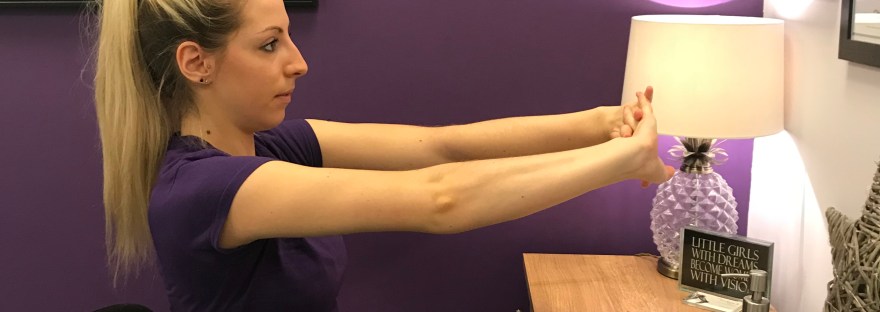
  • Reverse Hands Push Outs

With your palms reaching forward, hold hands together (link fingers) and extend your arms straight in front of you. Keep your back straight. Hold for 10-20 seconds and repeat 5 times.

  • Pray hands Position

Place palms together fingers pointing upwards, push your hands downwards to the middle of your chest. Hold for 10-20 seconds, repeat 5 times.


Let me know how you all get on – tag me @mollysportsmassage in your Instagram stories of you and your colleagues attempting these simple stretches! Happy Easter.

International Women’s Day

Today is International Women’s Day and although we are all posting pictures and quotes to empower women I wanted to investigate the history behind the day.

I found out that it is celebrated on the 8th March every year to commemorate the movement for women’s rights. In August 1910, an International Socialist Women’s Conference was held in Denmark. Inspired by the American socialists, German Socialist Luise Zietz proposed the establishment of an annual Women’s Day, however no date was set at the conference. In 1914 International Women’s Day was held on the 8th March, they think it is because it was a Sunday and now it is held every year on March 8th in all countries.

Each year there is a different theme to the day. In 2011 events took place in more than 100 countries to commemorate the 100th anniversary of International Women’s Day. In the United States, President Barack Obama proclaimed March 2011 to be “Women’s History Month”, calling Americans to mark IWD by reflecting on “the extraordinary accomplishments of women” in shaping the country’s history. This year the theme is ‘Time is Now: Rural and urban activists transforming women’s lives’.

Recently I have had so much support from women who are also in the fitness industry, they are encouraging me to try new classes and explore new business ventures. I have faced a few challenges as a Female Massage Therapist and I feel these challenges have only fuelled me to do even more and become the best Therapist I can be. We all need to stick together, respect one another and support each other. We are all on the same mission and we will get there faster if we work together.